Right off the bat I want to point out a few things I have learned while refinishing my wood dresser. The very first thing you need to know is that stripping the old layer of paint or stain off is NOT as easy as this Tik Tok portrays, or if it is, I certainly have done things very, very wrong. I also used the CitriStrip, as seen in the Tik Tok, but in my experience, it took a lot more effort than just running the tool up, removing the layer as you moved along.
The second thing you need to know is that when you see things like this: “bought for $50, made $525”, they probably worked for less than minimum wage completing the project.
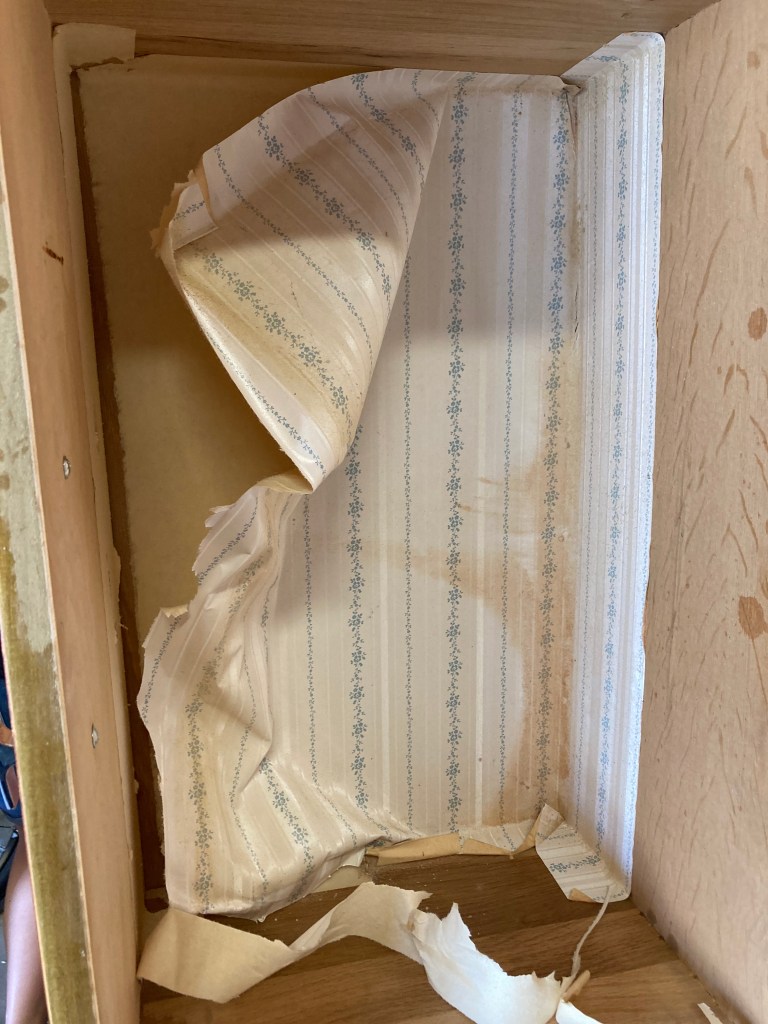
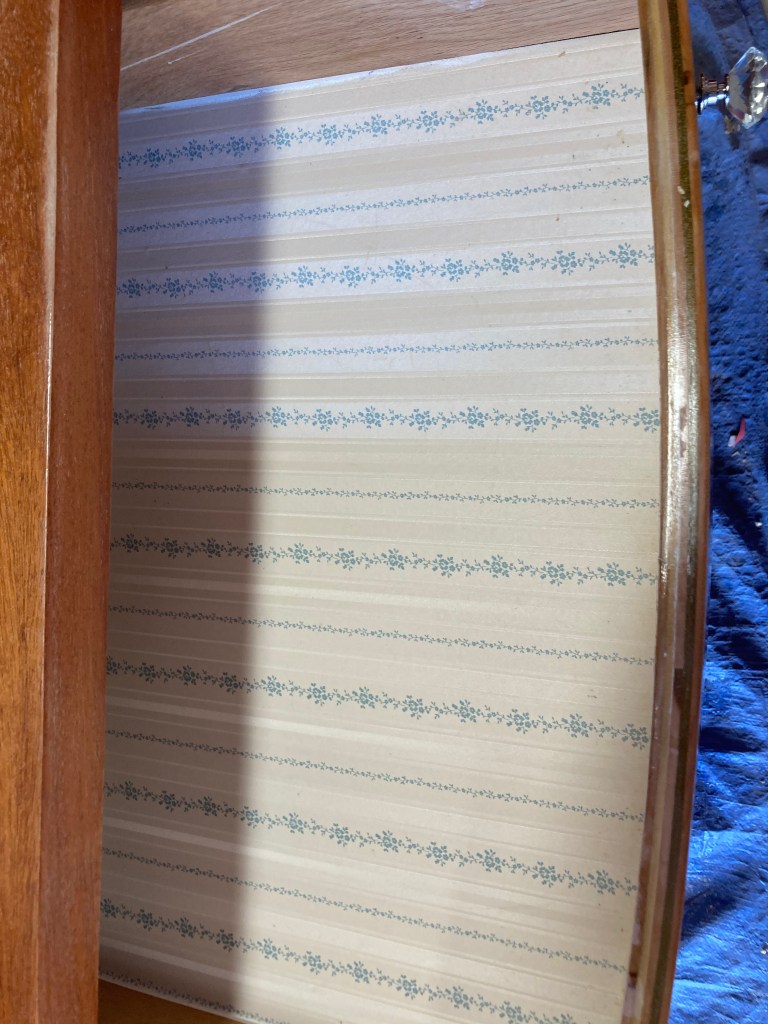
And lastly, you need to know: DO NOT do this. Please do not line dresser drawers with wallpaper because it SUCKS to remove it when that design is no longer trendy.
Let me demonstrate:
Ok, now that we have that straight, let’s talk about what did go right! The finished dresser ended up with five coats of the Tung Oil. Each coat made it more and more shiny, it is really pretty. A top protective layer is unnecessary. Check out that bling hardware! What 13-year old doesn’t want that!?
Bling pull handle hardware
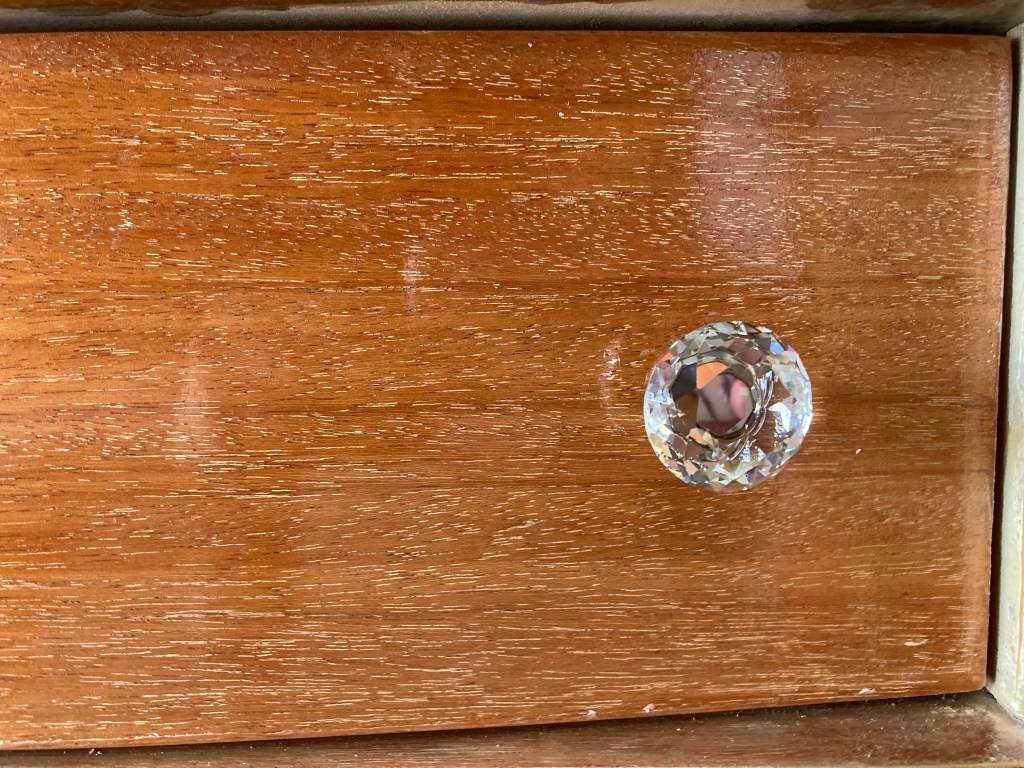
Glass knob hardware, top drawers
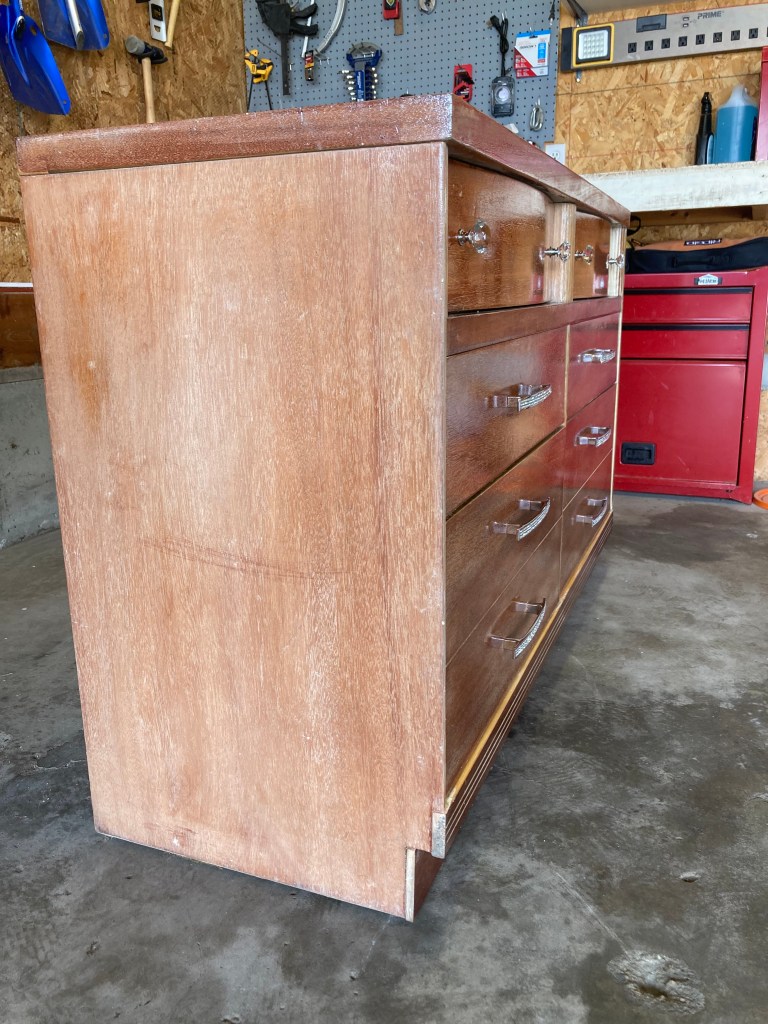
Finished side view
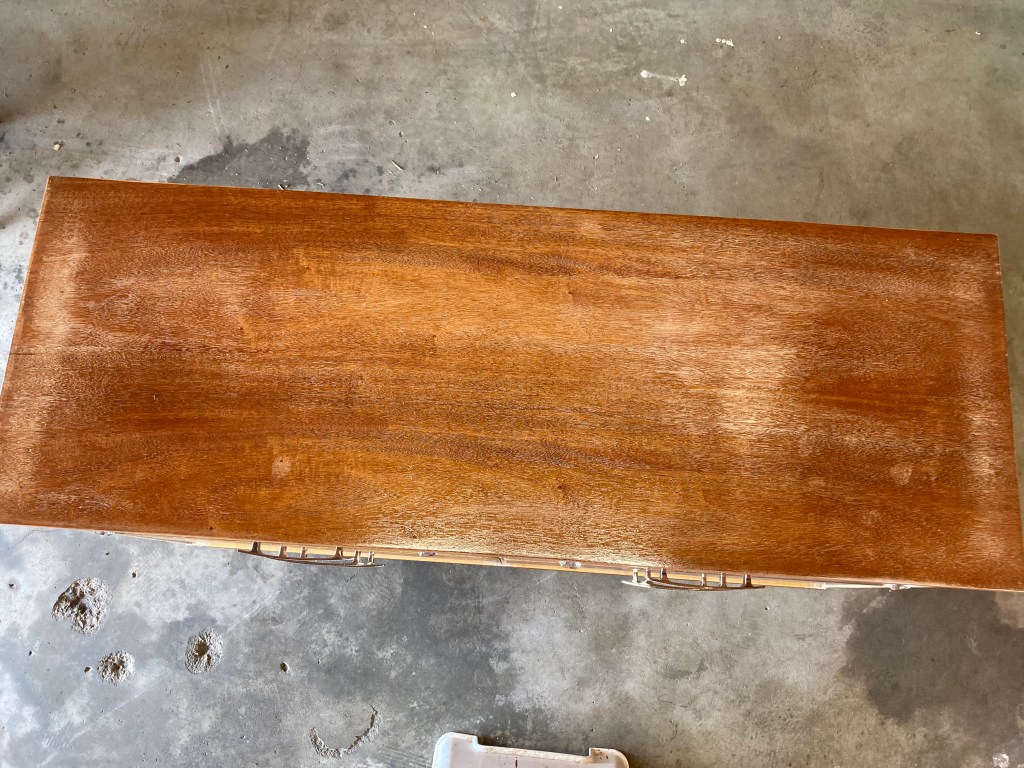
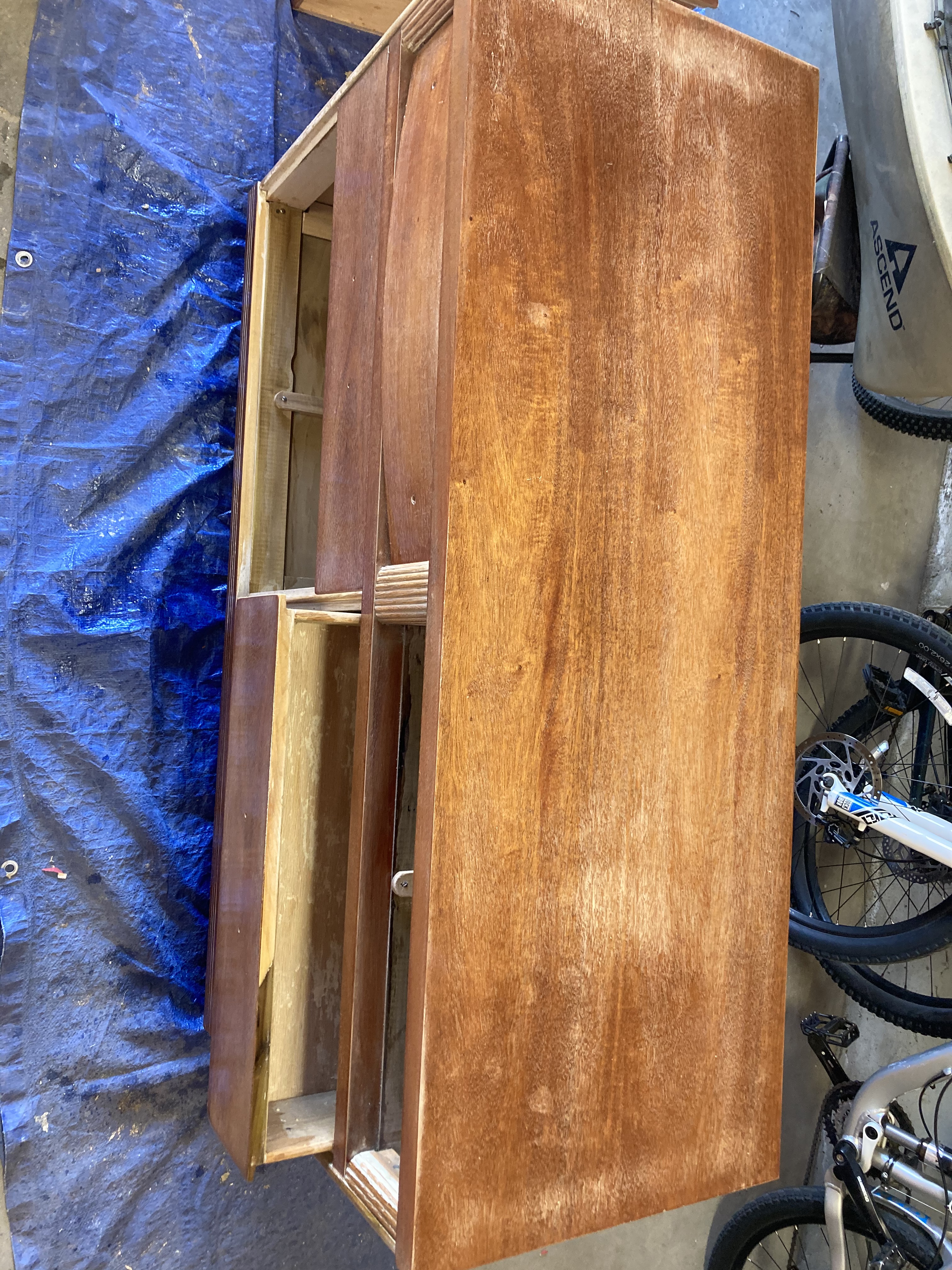
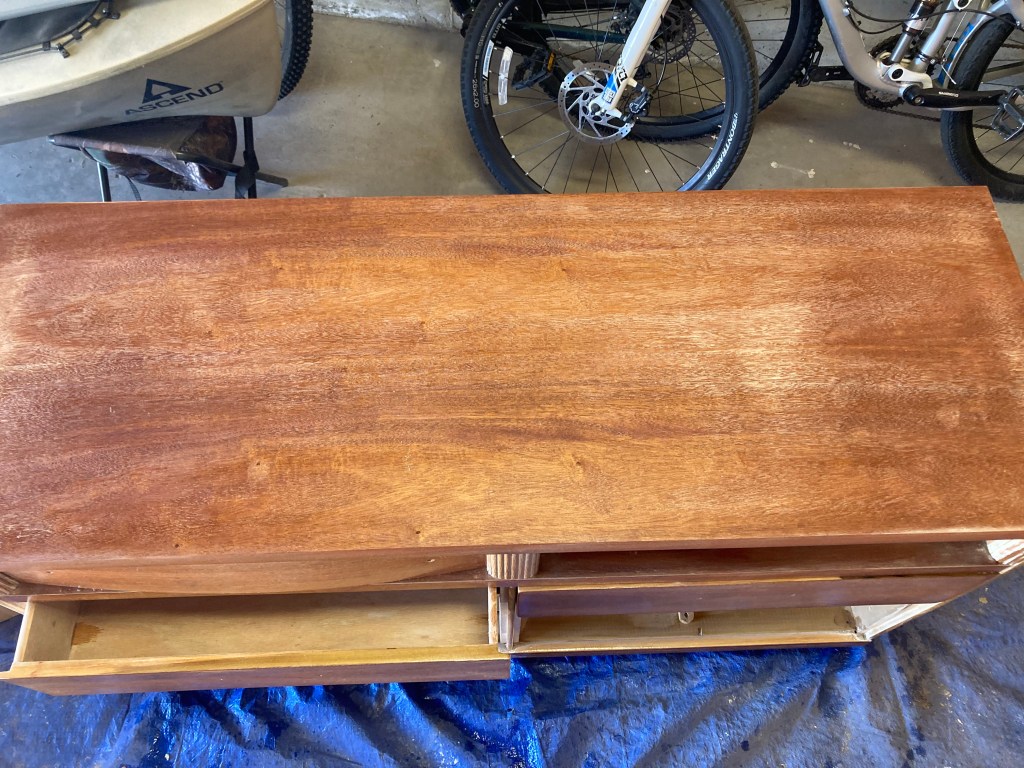
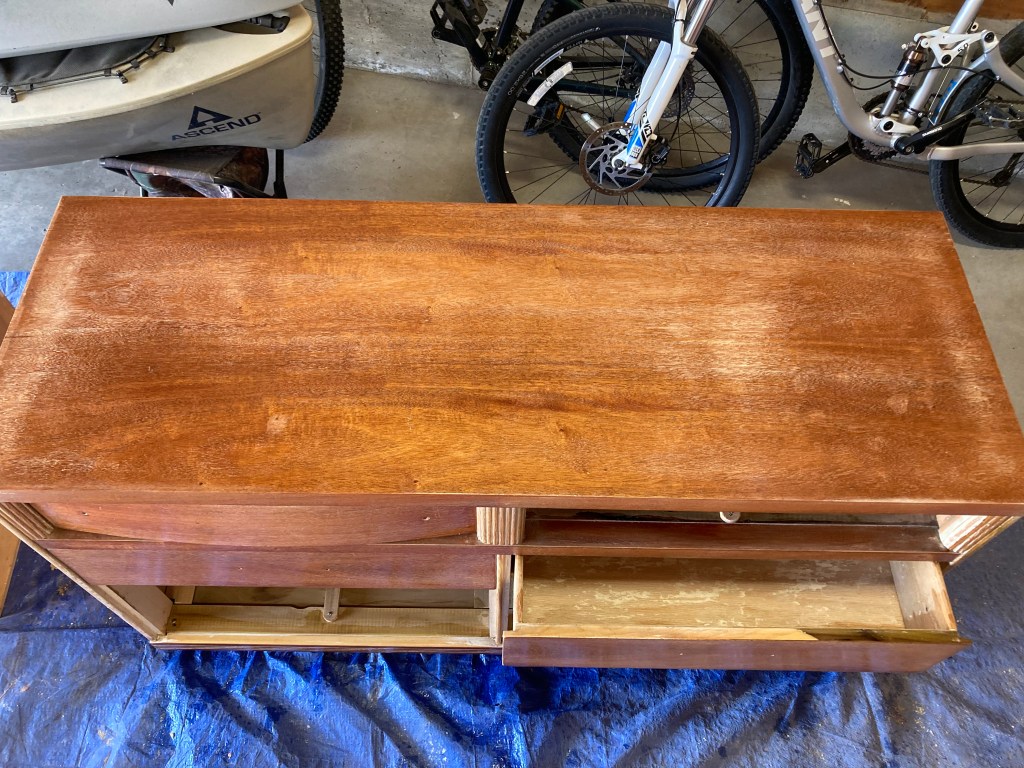
Finished top view
Inside view of drawers
Close up of inside drawers
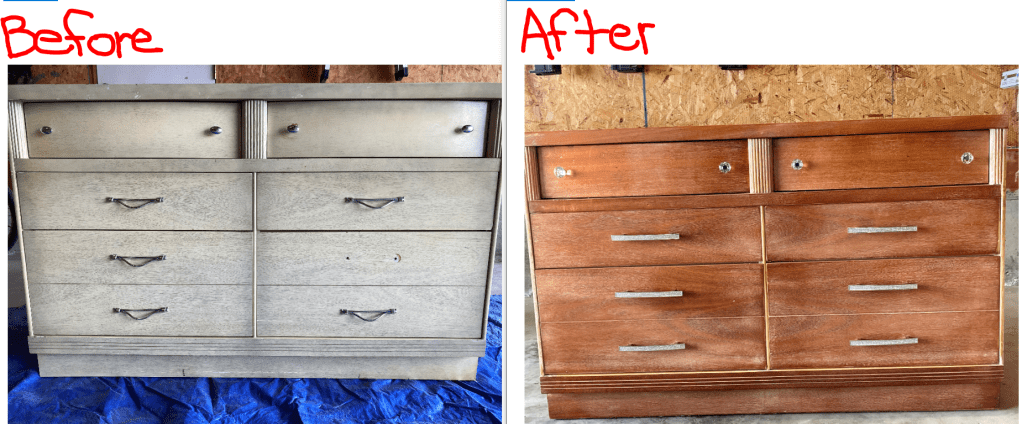
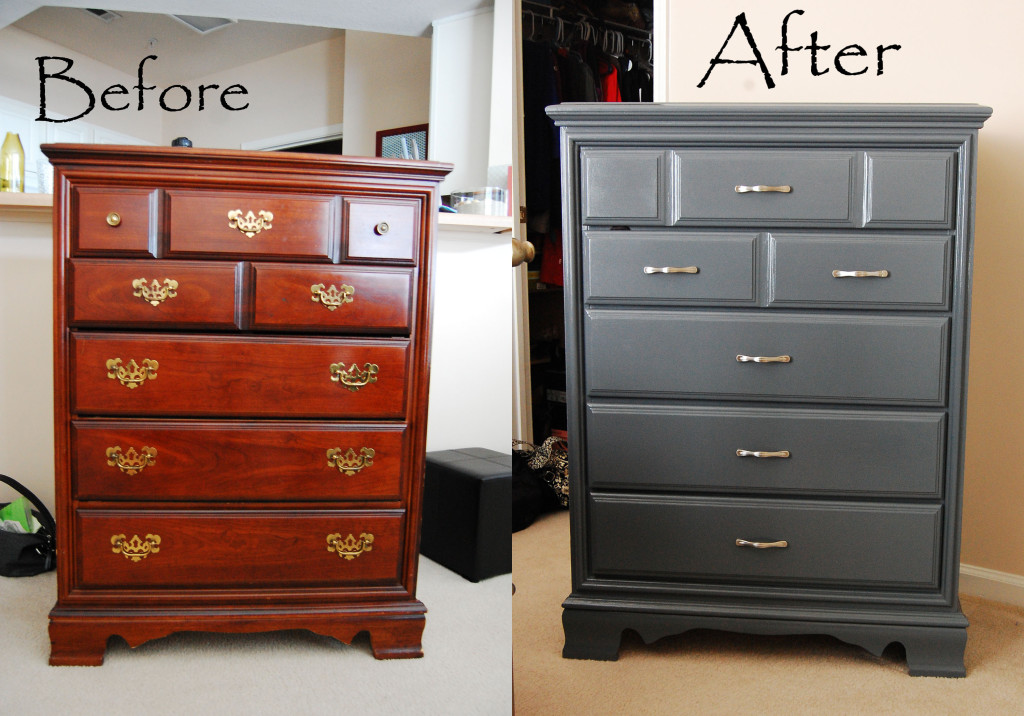
Left= before, Right= after
This last picture is what the wood dresser looks like in my daughter’s bedroom. We just happened to replace her flooring with hard wood and I think the wood on wood equals absolute perfection! Oh so pretty. Now she is begging me to paint. She is claiming she has outgrown the ‘baby’ purple. Oh, painting is another job where I earn less than minimum wage! OFF for another adventure…………
I had a very busy week preparing my wood dresser by adding two more coats of Tung Oil (24 hours apart). I absolutely love that with each coat it becomes shinier and shinier! It looks glossy to me and I like that look. 5 coats of Tung Oil is actually not necessary. I choose that because I like the shiny look, however, if you prefer a more dull look then 2-3 coats would be completely fine. The first 2 coats soaked right into the wood compared to my 5th coat.
Left: 1 coat of Tung Oil, Right: 5 coats of Tung Oil
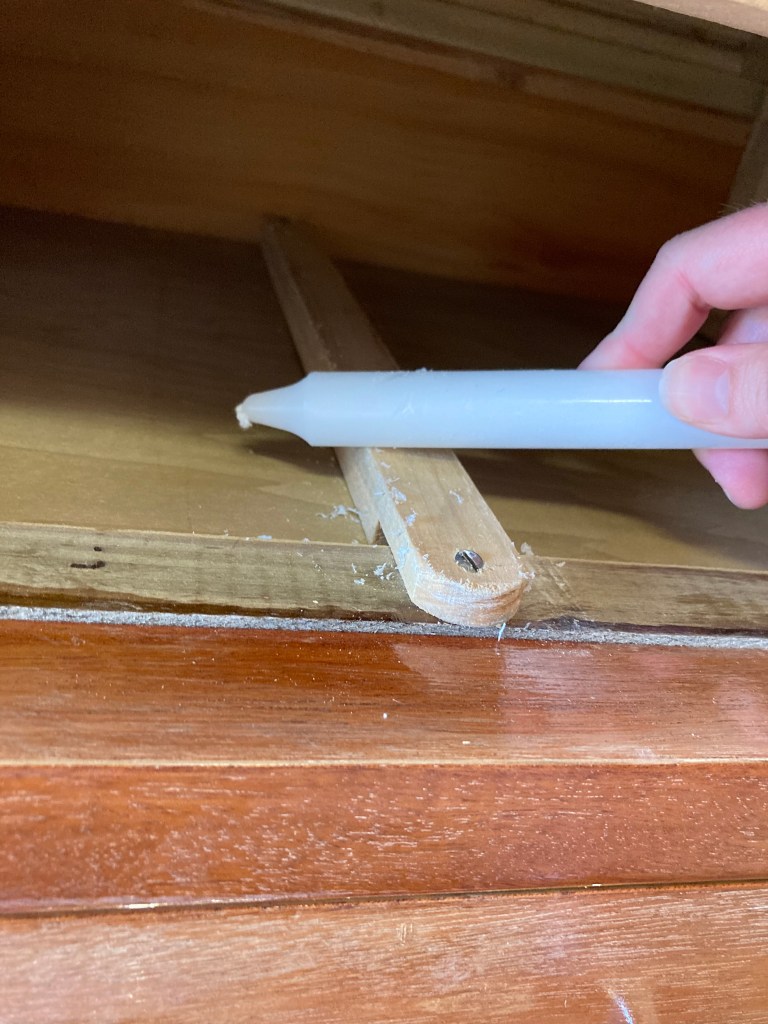
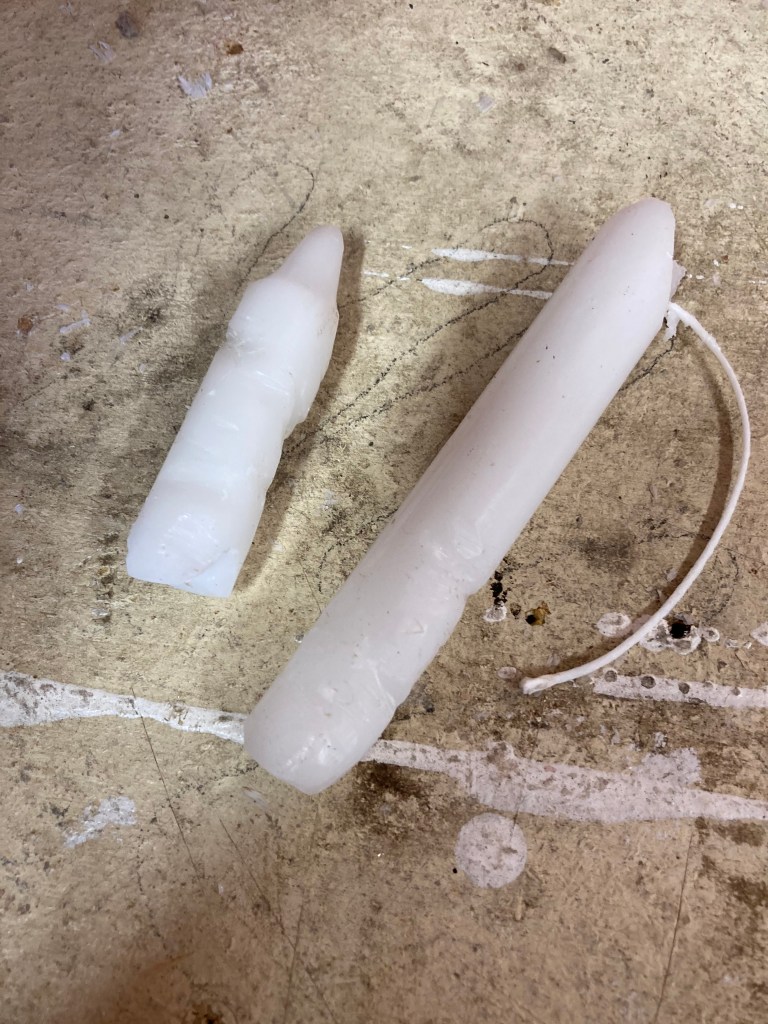
The next thing I did was wax the drawers because they were sticky and they did not slide nicely. I had only been told about this, I had no idea how to actually do it. I thought I had to melt the wax and somehow work with warm wax. Turns out, this was the easiest part of the entire project and this website was very helpful in educating me on this process.
I also made about 9 trips to Home Depot to purchase the new hard ware, an anticipated exciting part of the process but it was so frustrating! My 13-year old daughter claimed this dresser very early in the process even though she does not need it. This complicates placing it in her bedroom because it is a different style than her current dresser and, as it turns out, there are several different styles of dressers! That aside, she wanted to choose the hardware (you are in for a treat!) so she found the most bling possible. So I bought it and attempted to screw it on but my old dresser’s wood must be thinner than modern dressers because the screws were too loose. So trip #2 back to Home Depot to buy washers to act as a filler, otherwise the hardware knob would just spin around. Okay, problem fixed. But then I bought too many knobs and not enough pulls. Trip #3 to return and exchange and luckily Home Depot has an excellent return policy. Next, I attempt to attach the pulls but they are too long, they don’t fit! Are you kidding!? I did not know these were measured, I had assumed they were a standard measurement, but NOPE! Now I am nervous because my dresser is very old and I am concerned that my required size is no longer available (and I still need the 13-year old’s ‘bling’!). Trip #4 I discovered that there are many sizes actually available! Who knew! And they had the bling hardware, in the size we needed. So, okay, 9 trips was an exaggeration but 4 did seem a little excessive to buy what I thought was a simple (but oh so surprisingly expensive) step of refinishing! All said and done, the dresser has (very blingy!) knobs and pulls on it.
The part of this project I have yet to finish is removing the wallpaper layer from the drawers. This job absolutely sucks so I have left it for last. It is very labour intensive and quite messy.
Cybersleuthing my partner was a creepy experience for me, not because there was anything weird about my partner but because I felt I was invading her privacy, like I was overstepping my bounds. I felt like there was something wrong with me, looking for anything I could about her. I came to know her, some very specific details of her life. I wondered how easy it would be to steal her identity. I have no idea how to go about this and I have no plans to but I think an experienced person probably could. My partner was easy to find on Facebook which did not really surprise me because we are about the same age and Facebook includes many in our generation. This made me reflect back to Katia’s lecture on June 3rd, 2021 when she said “that if you don’t have a Facebook, you are considered suspicious”. When I began cybersleuthing my partner and I discovered she was on Facebook, my immediate reaction was “oh thank heavens she has Facebook” (not because it made my cybersleuthing easier, but because her having Facebook somehow made her ‘normal’).
An area in my life I have taken great pride in is that I do not (think I) have a digital footprint. So imagine my surprise when I read the article Having Multiple Online Identities is More Normal Than You Think and discovered that many people have multiple accounts using multiple platforms! My own teenagers have “spam” accounts but I thought they were weird, the minority, the exception, not the going (and growing) trend! I do wonder how people have time to manage so many online identities because it sounds exhausting. The author makes this point as to why people have multiple online identities: “Different sites, different audiences, different purposes”. Taking a look at Jon Ronson’s Ted Talk reminds me that we need to be very careful what we post online because it all leans in to our digital identity, the good and the bad, the positive and the negative, our charm and our mistakes.
Watching Monika Lewinsky’s Ted Talk was hard because she made a mistake, right at the beginning of what has become known as digital identity. At the young age of 22 she “fell in love with my boss”, who just happened to be the president of the United States. People who did not know her, the situation, or most likely anything else to do with the circumstance made horrible comments that we now call “public shaming”. This “culture of humiliation” is inappropriate, very harmful and dangerous and we even risk losing our voice in a culture in which “voiceless people found they could now have voice” (Jon Ronson). I am sitting back, taking all this in, trying to understand and digest it all and I more clearly understand my hesitation to have a digital footprint. Is seems as though there is NO room online to make a mistake or to post anything less than what appears to be perfect.
Madison Holleran’s story is an excellent example of trying to achieve an online presence exhibiting only perfectionism. Holleran became so enthralled with the idea of perfection both offline and online that it ultimately cost her her life. She observed her friends unfiltered ‘perfect’ lives and she felt inadequate, that she could never achieve this level of happiness, of perfectionism. Unfortunately, it became too unbearable for her to bear.
Even when we are offline, we are online. There is no longer a difference. “We don’t have an ‘online me’ and an ‘offline life'”(Katia Hildebrandt, lecture June 3rd, 2021). The perfect example of this is Justine Sacco who made a Tweet to her few Twitter followers, jumped on an airplane, and by the time she landed, that Tweet had traveled around the world faster than she was, unbeknownst to her, and ultimately had her fired from her job.
My key takeaways from this lesson are: #1: I need an digital footprint because if I don’t create mine somebody else will; #2: By giving real life experiences, we can learn and be taught about digital identity; #3: The internet works very quickly; #4: If I need to push something further down the google search results then I need to be posting as much as possible to get people to click on those instead of the undesirable content.
Top view, stripped and sandedTop view, Tung Oil coat #1Top view, Tung Oil, coat #2Top view, Tung Oil coat #3Top view, before and after
I had to start with the pictures because this has been the part I have been most looking forward to! Getting the wood coat on! I was so excited to see the dresser come alive! I decided to use Tung Oil rather than a wood stain or wood paint because I liked that its purpose it to highlight the natural wood as opposed to completely changing the colour. The one thing you have to know about Tung Oil though is that it STINKS! And the smell lingers for dayyyyyyyyyyyyyyyyyyyyyyys. I applied a new coat of Tung Oil every 24 hours. The directions indicate between 3-5 coats can be applied. With each coat it becomes shinier.
I took a few videos to highlight my process.
Sanding is more work than I anticipated!
Applying the first coat of Tung Oil
This dresser has six drawers and the drawers are each lined with wallpaper. I hate this! So I decided to remove it. Possibly a bad idea based on the effort it takes to remove!
My week has been extremely busy with this learning project partly because I want to apply 5 coats of Tung Oil therefore it requires my attention for 5 consecutive days. I did have to do some research on how to remove wallpaper from the wooden drawers because what I was trying (‘elbow grease’) simply wasn’t working. I sure wish I had looked at this website or watched this YouTube before attempting to remove the wallpaper! I feel silly now!
I still have a few things left to complete: 1. I want to give it two more coats of Tung Oil; 2. It appears it needs a ‘protective’ layer of some sort (this needs further research); 3. The inside of the drawers need more work to clean off the remaining wallpaper; 4. The drawer runners need a “wax” coat to make the slide smoother (this needs further research); 5. I need to buy 16 drawer handles.
I am excited about this project, happy with the progress, and how the dresser is coming together.
The first thing I discovered about the relationship between digital citizenship and the SK curriculum is that there is not a lot designated towards learning about digital citizenship. Therefore, in order to incorporate digital citizenship into the curriculum I see myself integrating it in my classroom through creativity and developing cross curricular lesson plans. These lessons will require students to delve into the digital world in a safe and controlled manner, under the direction of their teacher. The following lessons for grades 5, 6, 7, & 8 are lessons that I would actually use in order to include digital citizenship in my classroom. Mike Ribble suggests 9 elements of digital citizenship that I need to be cognizant of in my classroom.
Grade 7 Health Education requires students to learn about the importance of harmony in relationships. In the world now these relationships are also found online and are just as important as face to face relationships.
Outcome USC 7.4 Demonstrate a personalized and coherent understanding of the importance of nurturing harmony in relationships (with self, others, and the environment), and apply effective strategies to re/establish harmony when conflict arises.
Indicators: (there are 16, all could fit, I’m only including a few) a. Express insights into what makes a relationship harmonious. c. Create an informed personal definition of conflict. d. Analyze potential sources of conflict. h. Examine feelings associated with conflict. p. Demonstrate the basics of two or three strategies for reestablishing harmony and for resolving/managing conflict.
I would incorporate Mike Ribble’s element of Digital Etiquette in this health lesson because the outcome is requesting students learn the importance of harmonious relationships, and this now needs to include the digital world. Examples of poor harmonious online relationships are easy to find online, which students are exposed to. Examples such as these can create conflict therefore this becomes an appropriate way to teach grade 7’s about how to apply effective strategies to re/establish harmony when conflict arises. Digital etiquette is a skill that needs to be taught at school because adults are not always great at this either.
Grade 8 Science class requires students to research various ideas and theories, past and present.
Outcome: CS8.3 Distinguish structural and functional relationships among cells, tissues, organs, and organ systems in humans and how this knowledge is important to various careers.
Indicator: b. Research various ideas and theories, past and present, used to explain the composition of the human body (e.g., living organisms were made of air, fire, and water; and body is animated by spirit).
I would consider Mike Ribble’s element of Digital Access for this grade 8 science class because the students are asked to do research on something from the past. Although the indicator does not specify where and how to complete their research, it can be assumed some students could turn to the internet. This could cause a barrier for some students though, especially remembering 60% of the world’s population remains offline, because not all students have equal access to computer devices, or even the internet.
Grade 5 Arts Education encourages students to create a dance based on popular/ current dance trends.
Outcome: CP5.1 Create dance compositions inspired by pop culture (e.g., street dances, current dance trends in music videos).
Indicators: a. Investigate potential sources of ideas for dance related to pop culture (e.g., current street dances, popular dances of different eras, TV dance competitions). b. Pose questions about pop culture to explore through a dancemaking inquiry process (e.g., What popular dance movements, styles, and conventions could we include in our own dances?).
I would consider Mike Ribble’s element of Digital Communication in this lesson because we need to be careful what we post online and “how that will be conveyed online in the future” (Katia Hildebrandt, lecture June 1, 2021). This class outcome has students create their own dances based on current dance trends found in music videos. The following videos have been uploaded to YouTube within the past few years, therefore are considered “current dance videos”. The teacher’s job is help the students understand what is appropriate to put online and they can use the THINK model to help them decide what is appropriate. Using the following videos as possible guides, the teacher can help the students understand what is appropriate to post online (the first two videos are examples of inappropriate dance moves for grade 5’s to post online). Even though the outcome does not require the students to post their final dance composition online, many students do post dances online, therefore they need to understand how to safely and appropriately do so.
These two following videos are more appropriate for grade 5’s to post of themselves attempting similar moves online:
Grade 6 Social Studies encourages students to examine power and authority.
Outcome: PA6.1 Examine the relationship between an individual’s power and authority and the power and authority of others.
Indicators: b. Give examples of the forms of power (force: gangs, bullying; authority: leadership of an organization; influence: clergy, charisma) in the local community. e. Describe diverse ways in which groups and societies, especially those groups involving young people, deal with competing claims for power.
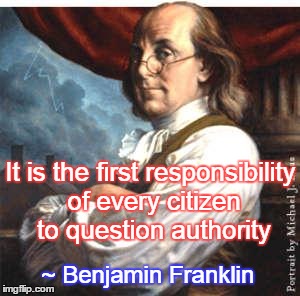
This is a great way to integrate Mike Ribble’s element of Digital Literacy because so much false information floats on the internet in regards to power. This would be a great lesson for students to learn how to research if something is true or not. Our students need to learn how disinformation leads people astray by giving false information. The below meme could be used in this grade 5 lesson:
Are these quotes properly attributed? How do you know?
The above meme started circulating online in about 2005, however, it is actually unknown (and unlikely) if Benjamin Franklin actually said the above quote that has now been attributed to him. The students can begin to understand digital literacy in regards to this lesson on power.
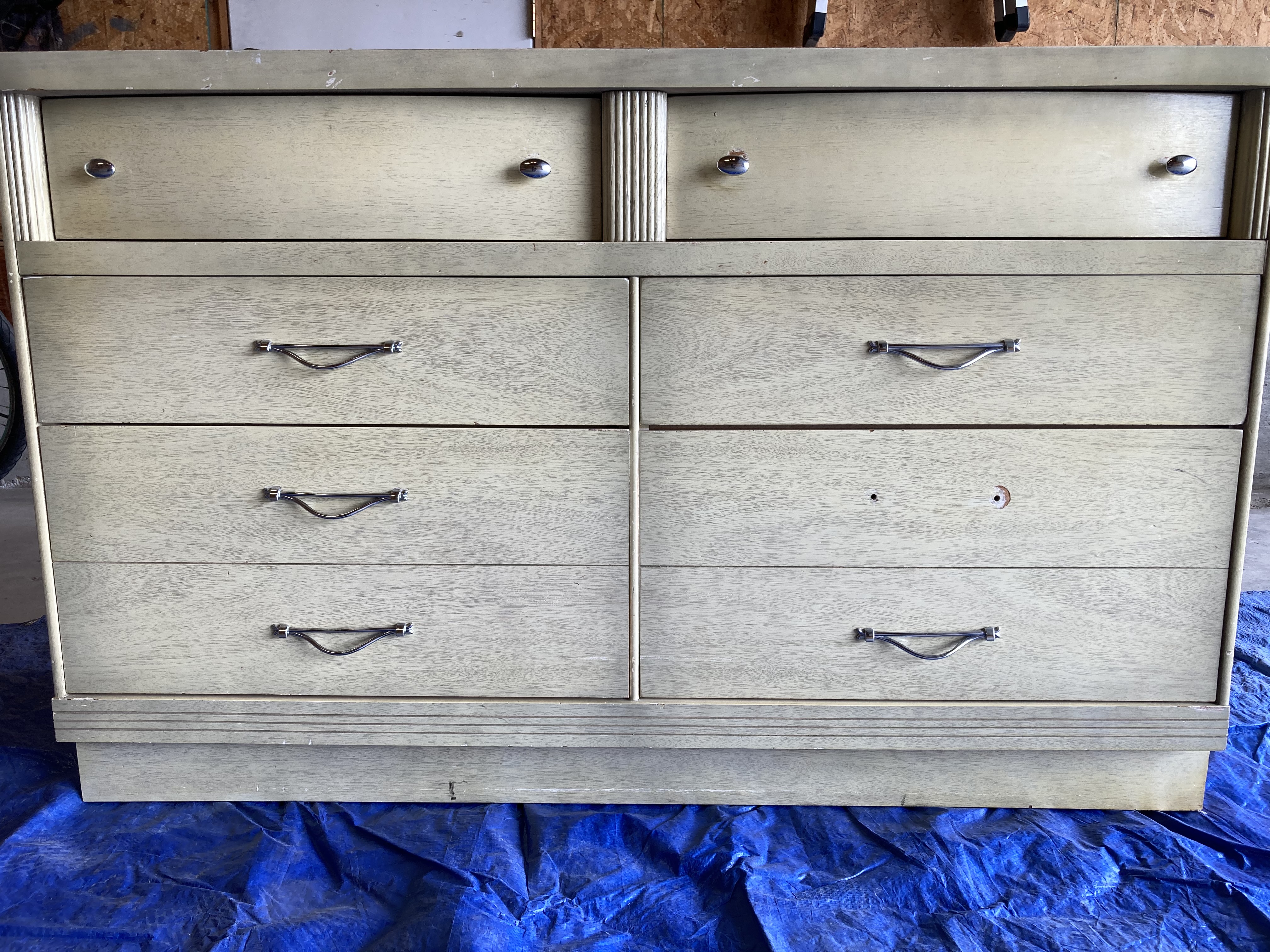
I am well into stripping the paint from my old wood dresser now. I have wondered if this is something I would enjoy doing as a side hobby so I looked into people who do! I found this fabulous podcast by The Zibra Blog where he interviewed Fallon Yates. Fallon gave her top five secret places to find/ buy old furniture for refinishing projects. I already had my dresser on hand, hiding in a dark corner of my basement so I am sure there are many people out there in a similar circumstance! These pieces of furniture are often advertised on Facebook Marketplace, auctions, yard sales, second hand/ thrift stores, or random people just give them away. I have also been looking at refinishing artists for tips and things that have worked for them. Jeanne’s work used a lot of color such as pink and blues, which surprised me. I feel excited to get to the stage of covering my dresser in color but I am still stripping off the old, ugly green paint!
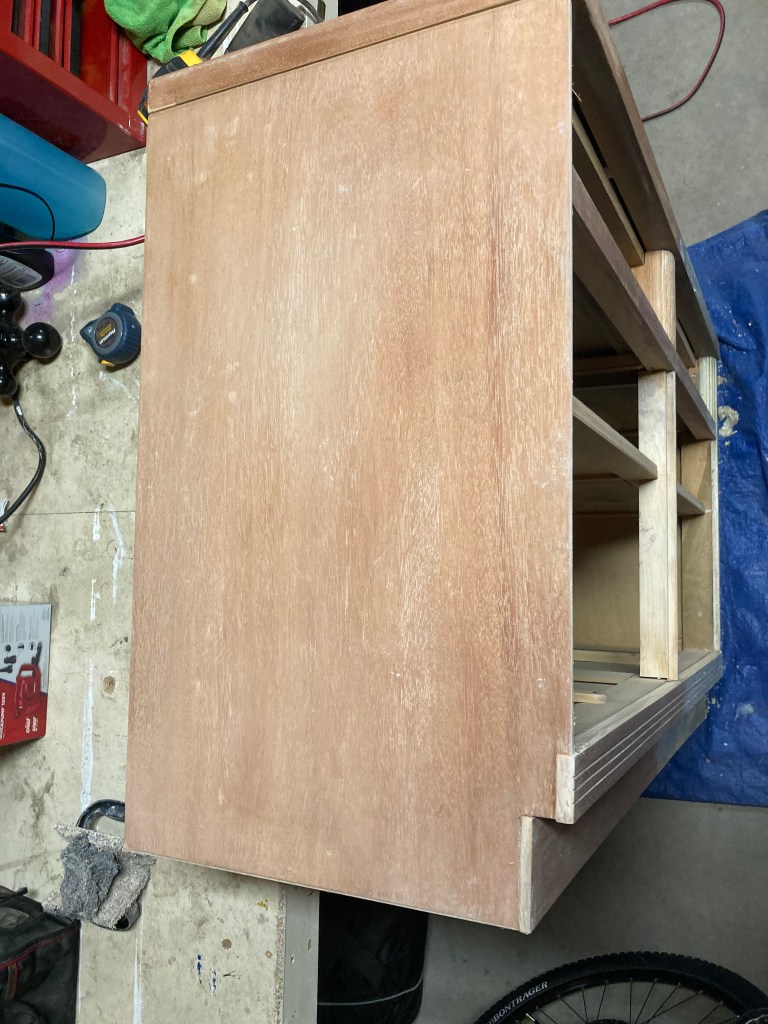
My dresser project, tipped on its end for ease of stripping old paint
I have not decided if I want to paint or stain this dresser when I am done. I looked at the many online pictures and many seem to be painted. This must be the fad right now, however, I just stripped paint off and it is really hard work. I worry that the paint colour will go out of style and then I am right back to where I started! Look at this example I found online:
I think stain would be nice but then as I was watching a YouTube video, she suggested using something called “Tung Oil”. Now I really feel overwhelmed with options! And today I just discovered there is something called “chalk paint”! YIKES! Too many options. So let’s delve into what each one is!
Tung Oil has been around for thousands of years, originating in China. Because of its versatility, it can be applied to concrete, wood, stone, brick, or even metal surfaces. It requires anywhere from 3-5 coats and takes time to dry but is still popular because it is environmentally friendly and easy to use. I like that! How do you think it would look?
Left side of the dresser, tilted on its end
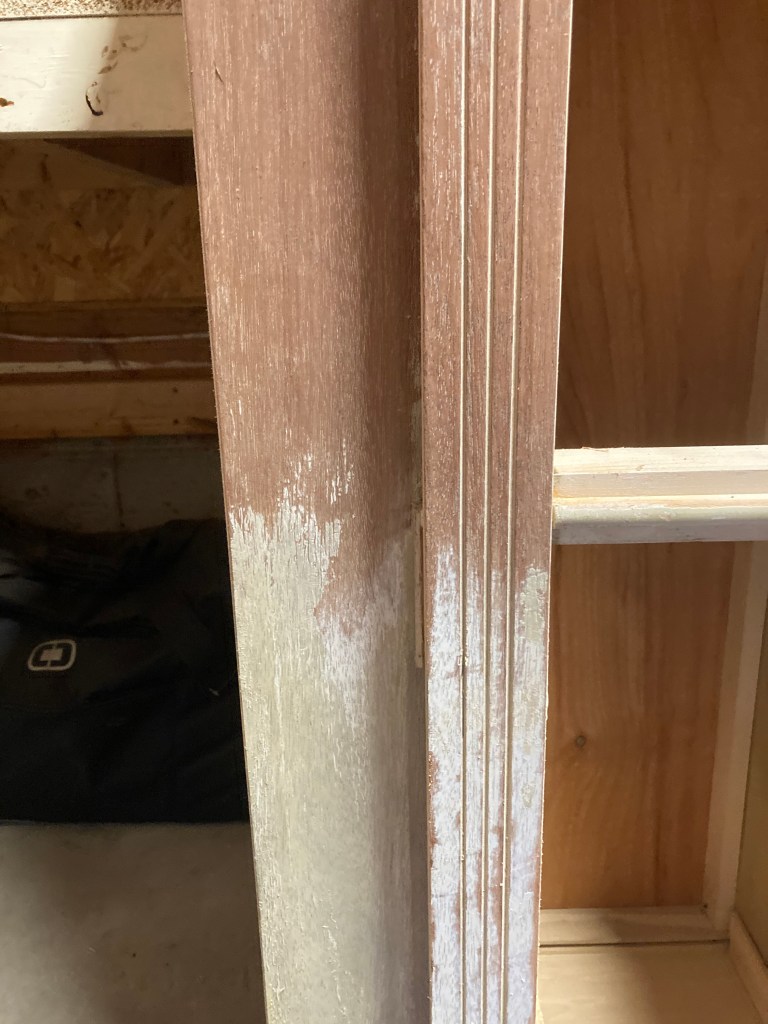
Stain. What is stain and how is it different from Tung oil? Well, wood stain is meant to enhance the colour of the wood enabling the natural wood grain to be visible. Stain is technically tinted, therefore the process is similar to painting. Therefore, stain actually changes the colour of the wood, unlike Tung oil. I am not sure what to think of this. Do I like the colour of the dresser? Here is a close up picture:
Chalk paint is meant to allow for more freedom and creativity so that painters can change their mind part way through. Chalk paint does not require a priming coat and is used to create a time-worn, vintage finish which is very popular right now.
I am content saying I am not interested in chalk paint and that I am leaning towards Tung oil. I think that is the look I am wanting! Within the next week I will get to go shopping for new hardware! This is starting to take shape! It has been a massive effort to remove the old green paint. I was not expecting it to be as difficult and time consuming as it has been but it has been very rewarding. I like that I can see immediate results each time I work on it!
In Michael Wesch’s talk, he quoted the fact that 88% of videos uploaded to YouTube is “new & original content”. This is simply incredible, there is no other way to describe it. I looked at my own YouTube channel and realized that I have over 30 of my own “new & original content” uploaded there, all of which have been uploaded in the past 3 years. Again, incredible. The reason I find this so incredible is because I think back to my childhood when camcorders became popular. They were bulky, expensive, and awkward. I was six the year these were invented and they looked like this:
Image credit: SSPL | Getty Images
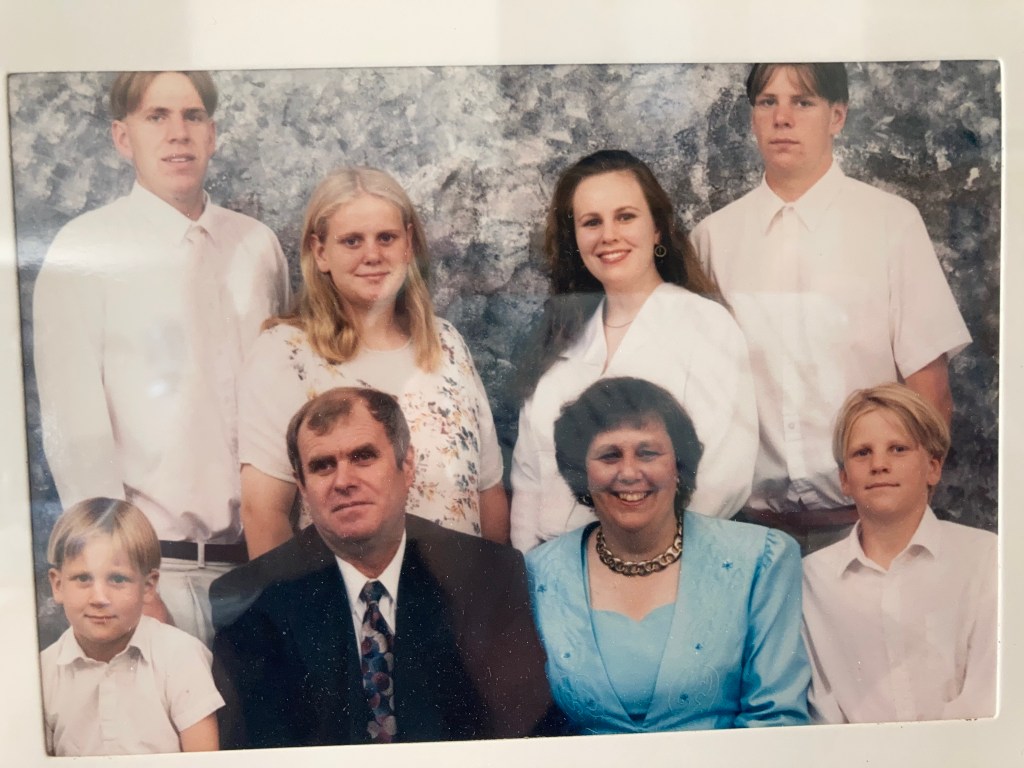
Now, my family did not own one of these because family’s of the 80’s, as mine pictured below, did not get extra’s like camcorders because they were so expensive. I remember watching America’s Funniest Home Video’s as a child, in awe of the possibilities being recorded.
Ferguson Family, early 1990’s.
Fast forward 22 years to 2005 (I am now 28 years old) and YouTube is born. This becomes important because, as Wesch states, this becomes a “celebration of new forms of empowerment”, a “celebration of new forms of community that we had never really seen before”.
What becomes even more astonishing is that two years after the birth of YouTube, the first iPhone is born, hence the beginning of the ability to film/ record video with a device that fits inside our pocket that no one ever leaves home without and 85% of people own.
Yes, I am older than most university students, but this all happened within less than 2 decades! I am sure the younger generation will easily look back in their older years and be astonished at the technology that emerged because it develops at ever increasing rates.
So what does this mean for me and my future classroom? The first thing I think about is privacy. I need to make sure I have the proper permissions before I ever post anything on any social media. I love the fact that educators can, and should, use technology in their classrooms. Students are using it so let’s meet them where they are. I reflect on Katia’s slide displaying all the popular social apps youth are using right now and it overwhelms me. YouTube, SnapChat, Instagram, Tik Tok, Minecraft, Roblox, Fortnite, Among Us, Discord, Reddit, and Twitch are just a few. Wesch describes this as “linking people in ways that we have never been linked before”. I need to be aware of what technology my students are using.
So, sounds awesome right!? I agree. But as with all good things, we need to take precautions. This new way of interacting in our world comes with risk and we need to be aware of these risks and talk openly about it with our students because if we aren’t talking, who is?
In our class lecture we discussed what is known as the “mediator” and that this mediator has disappeared in our new digital age. Parents, as an example, used to act as a mediator when the house phone rang. Now, parents do not even always know who their children are talking to. In these virtual communities, who knows who a child is talking to and where in the world that person is living. And there are predators lurking in not so dark corners anymore to lure youth in.
What does this mean for schools in general? Schools will certainly need to rethink things because the world now consists of “user generated content”. We have an “integrated media scape” that students are embracing. Wesch’s comment “when media change(s) human relations change”. Educators are going to need to be creative on how we develop relationships with our students because of this shift and change. Schools will need to adapt and be flexible. And many teachers and schools are!
To rethink the idea of schooling and education in our networked, participatory, and digital world I need to not be afraid of it! Sometimes fear of not understanding how some technologies work limits me. By choosing not to participate in this digital world, we limit ourselves as well as our students. Educators should meet students where they are at, and they are all using some type of technology. I think about the in class example Katia gave of teens eating Tide pods or participating in the black out challenge. We definitely need to re think how to participate in this digital world because sometimes our students can be misled in the big, digital world and they need educators to understand and not judge their digital realm..
How can we balance the challenges of our new digital reality with the possibilities that it offers? Balance is difficult in most things and I have found it comes mostly through trial and error. There is not a recipe to follow or a one size fits all solution for every classroom/ teacher. Choosing to not engage in any technology is not the right angle and yet trying to tackle too much is unrealistic! It is trying one thing and exploring and playing on that to see how it goes. Luckily “information is no longer guarded by institutions”, as Katia reminded us in class. This enables us the freedom to explore and try at least a few new things within the school year.
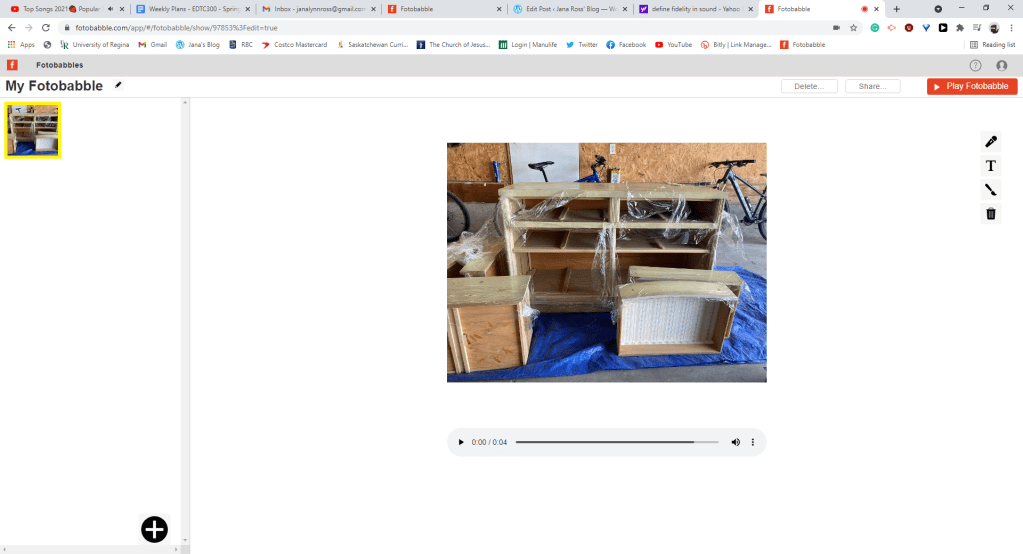
I am so excited to have discovered Fotobabble! And what a cute word! I am fairly familiar with Davinci Resolve and Audacity, which are open source tools that Katia gave as suggestions but I really wanted to delve into something I knew nothing about. I considered Puppet Pals and Little Bird Tales but these are both applications for iPads or iPhones. I own both these Apple products but I prefer to do my school work on my desktop computer (which is not an Apple desktop). So I tried Fotobabble and this is simply awesome! I LOVE it! You have to try it! I love that it is sooooooo user friendly. I did not need to google or YouTube anything in order to learn how to use it. It is extremely straight forward to use. It is a program that uses your recorded voice overlapping pictures of your choosing.
I began by uploading pictures I wanted.
Learning how to add pictures to FotobabbleAdd your desired photos easily
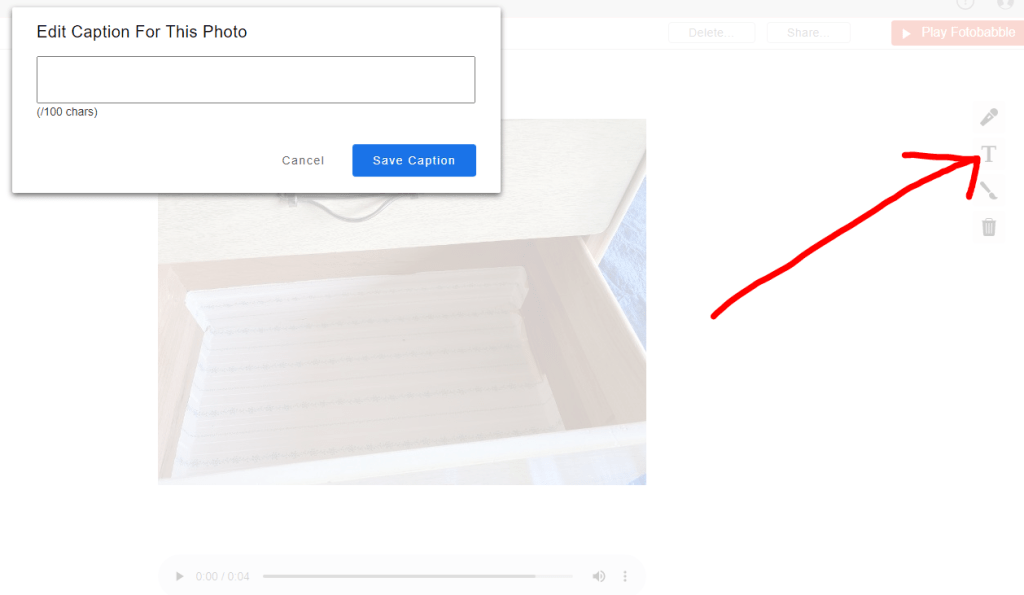
I then choose to create a caption (optional) for my photos.
Add a Caption (optional)
Next I recorded my voice that accompanies each picture. The picture automatically displays for the entire length of my voice recording.
Learning how to voice recordVoice record to accompany the selected picture
Disadvantages of Fotobabble is that I could not edit my audio at all; if I didn’t like the recording I would need to re record all of it (per picture). It cannot be uploaded to YouTube either. Another disadvantage of Fotobabble is that when I give the link of the project to someone, it forces the viewer to Fotbabble’s website to view it. I would rather it be available directly on my blog instead of it being a link.
In comparison to Davinci Resolve, this program is more powerful and I can do far more with it, including uploading to YouTube. That said, it was extremely time consuming for me to learn and figure out. I also find the audio will randomly cut out, which seems to be a program glitch. It does allow for far more editing though. In Davinci Resolve I can upload audio, video, and pictures, unlike Fotobabble (pictures only).
Fotobabble, in comparison to Audacity, there is no comparison with audio quality, especially if I used a Zoom H4n recorder with Audacity, as seen here:
High fidelity sound recorder to upload to Audacitiy.
Audio that is created in Audacity or elsewhere can be uploaded to Davinci Resolve but not to Fotobabble. So Audacity and Davinci Resolve can be used together, unlike Fotobabble, you need to use Fotobabble’s own voice recorder, which is low fidelity.
I still think Fotobabble is awesome for small projects! I was easily and quickly able to create a project that is fun, interactive and catches attention. I was able to give my viewers a ‘tour’ of my project.
Fotobabble can be used in the classroom as an alternative form of journal writing. Students could take pictures and then record their thoughts regarding it, used to expand grammar, voice fluctuation, and pronunciation as opposed to just spelling. Or teachers could take pictures of their students work, particularly projects, and then voice record their assessment of the work. This gives the student the ability to see and hear the teacher’s feedback. These uses of Fotobabble fall under M, Modification, in the SAMR model because it changes what teachers are able to do in the classroom because the student created something. Fotobabble is especially useful as a form of remote assignments because it can be handed in and viewed online as compared to in person.
Twitter as a professional development tool is an excellent choice because I get to choose who I would like to follow on Twitter. I choose like minded people therefore their tweets are in alignment with what I am looking for. For example, I follow Syndey Hoffman and she tweeted an article that provides alternatives to traditional book reports. I love this because I enjoy out of the box thinking for classroom assignments and this article provides that. Due to a lack of time I would never have enough time to sort through all that is available online, therefore, by relying on those I follow, they help give me access to things I value.
I would attempt to use Twitter in my classroom because it is a fun and interactive way for my class as a whole to interact online safely. I imagine my class tweeting about a place-based project we are collaborating on. Or they could request resources for assignments such as this that was tweeted.
The #SaskEdChat was very interesting and fast paced. I have to admit, I felt completely overwhelmed with it at first. I felt I had to read every single comment that appeared on my screen and the comments were coming very quickly because there were so many people participating. I loved the learning environment though. I want to participate again! I like that chats are safe and convenient, we can stay at home rather than rushing out the door for yet another meeting. I appreciated that the chat was moderated therefore I felt that comments would not get out of hand/ inappropriate.
I actually like Twitter. I can see why Katia finds it so useful. At first I had a hard time understanding its purpose and role in my life because there is so much content available. I was reminded of Katia’s comments though: take what you can for now. I can save the rest for later! I can do that! My favourite thing about Twitter is that I get control over who I follow. This sounds simple enough (all platforms give you this option!) but it is significant to me because I choose like minded people that help me ‘sort’ the internet for practical and useful things in my career. Other platforms do not do the same level of ‘sorting’, even with AI.
















 Jana Ross